Showing posts with label Facebook. Show all posts

Saturday, September 12, 2009

Who is afraid of facebook?

In the last five years, social networking has not only introduced a new use of the internet, but has also changed our life style.

The first social networks were only used as means of amusement and pleasure, but today, the political and social lives of many users have been influenced by them as well.
The three web sites of Facebook , good for exchange of information, groups, and friend finding, Youtube, best for sharing videos, and Twitter, capable of spreading news very fast, were most useful for those professional users of internet.
The use of these three web sites in the American presidential elections, which became known as “net campaigns”, made clear just how effective these sites are for attracting the public.
Most social networking sites, with the exception of sites like “Club”, have always been filtered in Iran. But it seems this was less due to religious and ethical worries than to the fear that those sites might be used as a new kind of media.

When Facebook, a symbol of a new generation of social networking, became famous amongst Iranians, it was quickly filtered in Iran, and it was filtered up to last February. Then, surprisingly, both Facebook and Youtube became accessible again!

Conspiracy delusion or intelligence machinations?

When Facebook was finally available in Iran, hundreds of thousands of users registered in the first month. This sudden and unexpected passion for Facebook caught the attention of the web site’s management as well. Some reports say that after four and a half months that Facebook was accessible in Iran, the number of registered Iranians increased by 7000% !! And statistics say that today more than six hundred thousand people within Iran are a member of this site.
Even though Facebook never publishes membership numbers according to country, two indicators show that during the spring of 2009, this site became the most popular among Iranians. One is the report of international interactions in Facebook, which compared to the previous year’s season shows incredible increase of Facebook users in Iran. This compelled the Facebook management to make Facebook available in Persian, and by the beginning of the protests in June, Persian Facebook was already up and running.
The second indicator was statistics from sites such as Aleksa, which showed unprecedented increase in the population of Iranian users. And in the last few days before the elections, Facebook was the third popular site in Iran, after Yahoo and Google.
But what made those in charge of censorship on Iran, used to filtering every blog containing even the slightest anti-regime content, decide to make Facebook and Youtube available?

There were signs showing that the regime’s intelligence agents were monitoring and tracing opposition forces and journalists, and at the time some believed that Facebook was a great way to control secret and open movements. Others thought the government wanted to use Facebook and Youtube for election campaigning, as it had been used in USA, providing them with a reference base of 25 million users. However not only did we not see official Islamic Republic agents using Facebook and Youtube for advertising, but there also isn't a single fan page for Ahmadinejad in Facebook - where you find pages for all imaginable subjects!
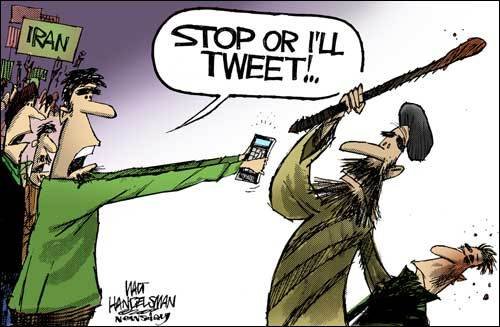
A third opinion, which was brought up later, was the possible part of Hossein Derakhshan and Payam Fazlinejad, theoreticians of the Revolutionary Guards and the Intelligence Ministery’s mental warfare, in directing an “election show”.
Therefore Facebook, Youtube, and some other politically active sites were crossed off the must-be-filtered list of the country, then reformists were permited to use the new media freely, and in the end the televised debates helped to heat up the “elections”.
In the history of television in Iran, there had never been this many viewers for a program and although most people also had access to alternative media, 90% of the population were watching presidential live debates on television. This means that almost everybody watched the debates.
This previously unimaginable campaign of the reformists in both the real and the cyber world resulted in a decrease in number of long-time election boycotters. In the last few days before the election, many of them were caught in the “wave of propaganda” of the middle classes and went to the ballot on Election Day.
However the curtain of the show went down on June 12th at midnight, when surprisingly Ahmadinejad was announced the winner.
So the highest participation rate in elections since the beginning of the Islamic Republic and the referendum went down in history as a success for Ahmadinejad, the winner with 63% of the votes.

Therefore, according to those who believe in a conspiracy planned beforehand, it becomes obvious why Facebook, Youtube, Twitter, and many other politically active sites were up made available until the “ election show”.
In the morning of the election day, the TV channels Persian BBC network and Voice of America were no longer available, the Green Wave’s internet television center was raided, all information sites and social networks were blocked, and then journalists were arrested, newspapers were controlled or even blocked – in short, a kind of military coup.
Facebook and Twitter, which had been made available to the public by the government itself, were called dangerous and conspiratorial; in his indictment against the protesters (or, as Iranian state media call them: “hooligans”), the Islamic Republic’s public prosecutor also identified them as tools in the intrigues and conspiracies of western countries and their intelligence agencies.

In this indictment, which was written based on past and present speculations of Hossein Derakhshan, the velvet coup d’état (the prosecutor prefers to use “coup d’état” instead of “revolution”) is said to have three branches: intellectual, executive, and media.
In the indictment, Twitter is accused of having delayed its maintenance, which required that the site be down for a few days, in order to help and support the “trouble makers”. Facebook is accused of “facilitating the interactions of Iranians with other countries during the commotions, so the enemies had better access”.
The third accused company is Google, who has put up “English to Persian and Persian to English translating software” to help “the hooligans”.
So those modern media, which tried to spread the voice of the people after all other media were banned from doing so, are now incriminated by the system.
Alternative sub-media killed the beast!

While in a court in Tehran people are facing trial for having sent an email, given an interview, or posted something on Facebook, blogs or Twitter, an independent media was created which had all the characteristics of a modern alternative media: Dynamics, independence, individuality, diversity, cooperation and self-encouragement.
During this two-month movement, these minor media were the only source of true information for the major ones. They were used for transmitting information and news from the streets; footage shot on people’s cell phone cameras were the only evidence of the ongoing protests, Twitter became the number one resource of spreading news, and blogs and facebook were used for disseminating information that was less accessible.
This means that due to extreme censorship, the normal flow of information was reversed, and now the major media had to use productions of normal citizens as news.
The effect of this new phenomenon was that many people, whether consciously or not, became “reporters”, and the flow of information found a new course, based on small independent sources which are at the same time dynamic and wide spread.
So the social networks had a strong impact against censorship, and at the same time created an atmosphere of cooperation, solidarity and mutual encouragement.
Today, whether these protests are silenced or not, our economical and political life would not be the same without Facebook, Youtube, and Twitter.

• Establishment of networks of likeminded people
• Public and personal news publishing
• Self-boosting and wave-creating
• Effect on everyday lifestyle
• Effective as a new model of public education
• Facilitating cooperation between people of different backgrounds
• Reflecting the cyber life
• Reflecting and unifying the public view
• Mental hygiene, and finding new connections

But it is obvious that the political applications of these networks are most important for those in charge of organizing the protests and spreading information, and, by the same token, also for security and judicial organs of the Islamic Republic. Although they can block television, radio and sites, images, news, rumors and information will find their way into social networks, and from there will be spread worldwide. Thus images like those of Neda Agha Soltan dying in front of the camera will remain recorded in history and in the mind of the people, becoming a symbol of protests against dictatorship in Iran.

Photos by: Raha Asgari Zadeh

Note: Footnote: Youtube cannot strictly be considered a social network, but its model of membership and exchange as well as the possibility to share links make it similar to a social network.

Published in: UK Indymeda, Daily Life, Deutschland Indymedia, Suisse Indymedia, Rise of Iranian People, and...

Sunday, May 31, 2009

Facebook and Election Campagin in Iran, Greens vs Blues!

Shohreh, a 23 years female art student in Tehran, began her day near noon with Facebook.


Sitting on the suffa, drinking her coffe and checking links, notes, status, photos, videos and comments on Facebook, but at Saturday 23th May, when she went to the usual page, found a message from Islamic Republic’s Communication minstry that Facebook is filterd in the country.
The message make her upset, that means she may lose all her online communication and friends, events and changes, but this was not really a big shock!
Everybody knew soon or later FB will be filterd again. We found that FB is not anymore filtred in Iran in last February while sudenlly got a lot of friend requests fro Iran.


Facebook itself condomed the filtering and called it shameful and even some of close adminstrations of Mossavi seeing it as a another pressure to cut accessing the information about Mossavi’s platforms, Yesterday even Kahrobi condomed it.
On Wedensday Mahmod Ahamadinejad stressed during a press-conference that he is not ordering the filtering of it. Following the confrence, facebook users in Iran found it open again.

Ahmadinejad also said: "I believe in maximum freedom of expression."
Many Iranians recently joined Facebook as a way of communicating and during election-time since it is an interactive media that allows involvement in politics whilst all other medias inside the country are under the harsh censorship.

However,It has been said at the first timeFB could help inteligence agents in Iran gathering information about journalists, deisenters, human rights activists, bloggers and women movment.
They even hacked my FB and Gmail and accessed some information about my projects. They also made a similar ID with my name added my friends or political activists on FB and asked some information, when I noticed report the fake ID to FB and they delet it.
Maybe at least they got valuable information about subjected people, like recent photos, recent conections and their planes, trips and even adresses and telephon numbers.


Since last month Iranian community on FB devided in two huge groups, pro-reformists (Greens) and pro-bycott (Blues).


Many groups and notes has published on defence of each approach, in one, pro-reformists blaming pro-bycott for Ahamadinejad’s victory in last election, in that election he got more than 17 million votes,however that election faced with the vaste bycotte movement and about 41% didn’t participate in second round of it.
But in the other one the debate is more hot, many people beliving participating in election means vote to Islamic Republic which has less legitmacy nowadays in public opinion.


When Mir Hossein Mossavi’s fans colored their profiles photos in green as a color of his election campagin, the deisenters also colored their profile photos in blue, then two big groups of Iranians in Facebook facing each other many online friends removed from each others list and arguments replaced with accusation and anger.


The Greens acctualy started the huge attack aginst bycooting supporters to make them passive, the kind of propaganda against the Blues, brought waves of critics, specialy when pro-Mosavi used a popular radical leftist’s song in their Youtube clip.

The song was belonged to the most popular leftist group called Fedaeian Guerilla fighted agianst Shah Regime, “Aftabkaran e Jangal” (The Sun seeders in Jungell) is a populae song still singing in Iran as a leftists solgan, but suddenly stolen by pro-Mossavi’s and broght a deep anger reaction on FB.


Mossavi, himself is accused as the one of main persons who leads the supression of political oppssitions and mass killing of political prisoners in 1980’s.


As the conforting between two wings in FB is climaxing, it is obvious pro Mehdi Kahrobi’s are in the minority and pro Ahmadinejad (Red) are a few.
In my Iranian list, I have about 30% Blue, 45% Green, 10% pro Kahrobi and 15% wanderers or not intersted to politics one.
From last week, pro Kahrobi’s who are using White seems being increased on FB, while pro Mossavi’s are getting more quite comparing the past week.


One of the most intersting debates on FB happened when I invited Ebrahim Nabavi my famouse coullegue who supporting Mossavi for the first online debate on Iran’s election on Facebook, about 200 people participated in the debate while they need to refresh the page can read each side respond.


But only my friends could read the text, so I put it on a blog and the blog got a number of 3500 visits at first night and 4400 at second night on Friday and suddenly both blog and FB has filterd in Iran on Sataurday, so the number of vistors decresed to about 550 vistors and only 20% of them were from Iran.


Iranians have a large number of FB users, one of FB PR’s told me they don’t have an exact data about countries detials, but some experts are estimating about 3.5% of Internet users in Iran participating FB from March till end of May, this should be about 700,000. Iran has about 20 millions internt users, one of the most accesses in the Middel East and at the same time one of the most restricted countries in the world for censoring the internt.


Shohreh, who told me last night spending less minutes to access FB than yesterday because of new proxy, finding many ways in her mail box and even wall to reach the FB, one of this helping message is from me, recomonding Firefox adds one for anti-blocking FB.
She still not decided wheather she wants to vote for reformists or want to bycote the election like last term, but following arguments and links on FB, communicating with people about current events and share her ideas on FB.


All togeather she wants have fun, she told me she just found her beloved high school clasemate in LA and just “meeted” a few intersting guys.
While we are aproaching the election time in less than 3 weeks, Greens and Blues countinung their competition to collect more supporters.


However for Shohreh and many young people like her Facebook is a part of their private life in social network, sharing hidden interstes with others, like other illigal things in Iran you can find in many houses, new Hollywood movies, Satelite TV and underground music.


Shohreh is now going to sleep, saying goodbye to me on chat while I am reciving many chat texts from different type of people from a peoet girl in Tehran to a leader of an opposite group, but she really happy can access FB tomorrow as usual tomorrow noon again, while she was online for about 18 hours, she said tomorrow she will post on FB her point of view about Ahamdinejad’s election speech on state TV.


Photo Credits:
1+4: Samar
2 : Behanm Sahvi

-------------------------------------

France 24 Observers' Version


26/05/2009 / IRAN
Facebook ban lifted: “the only place where we can talk about politics”


No wonder the authorities wanted Facebook banned. But Iranian Facebook users are heaving a sigh of relief today after access to the site was reopened this morning. So what was all the fuss about? One of our Observers in Tehran explains the election debates raging on the online social network and why President Mahmoud Ahmadinejad probably isn't a big fan. Read more...
Contributors Shohreh.
» Français عربية

Monday, March 09, 2009

Iran's New Internet Attacks on Dissenters

Omid Habibinia
February 25, 2009


In recent weeks, there has been a notable increase in Facebook "friend requests" from colleagues and friends in Iran. It seems that someone has decided to allow more Iranians access to the Web site, at last.


Facebook is one of the most popular online social networking venues among Iranians and it's estimated that over 200,000, mostly living abroad, are members.

Alexa.com, which collects Web traffic and ranking data, shows that a quiet but significant change took place among the usual top-ranked Web sites' weekly visits inside Iran. However, blog providers remain on top on the list — Blogfa, a free Persian Weblog service, claims to have more than 1,500,000 member blogs. Other providers, including Persian Blog, Mihan Blog, and Parsiblog are said to have an estimated 700,000 members, while roughly 300,000 Persian users frequent Wordpress, Blogger and Blogsky.

Iran is credited with having the third largest blogsphere after the United States and China, with 2.5 million blogs drawing approximately 5 million hits per day. It is estimated that Iranian bloggers tend to update their blogs on an average of at least once per week.

It is well known that the Iranian government has been filtering online political dissident and critical blogs for years. This has forced bloggers to search for other less conspicuous Web venues to exercise their right to express themselves freely. Until last month many such providers, like Blogger and Wordpress, were banned by most Internet providers in Iran.

The Islamic Republic is notorious not only for banning and filtering blogs, and the Internet generally, but also for inflicting heavy punishments on non-conformist bloggers, such as kidnapping, imprisonment, and torture. At the present time there are about 20 bloggers, including five women's rights activists, in jail where there are many stories of suspicious suicides and deaths.

A committee drawn from the Ministry of Intelligence, the Islamic Republic of Iran Broadcasting, the High Council of Cultural Revolution, and the ministries of Communication, and Islamic Guidance and Culture are responsible for the filtering and banning activity.

Reportedly, more than 5 million sites have been banned in Iran, including political, entertainment, scientific, adult, photography, sharing, and social networking venues.

The filtering has also affected some religious Shiite sites, based on some Fatwa content featuring Islamic guidance on sex and marriage. The committee's software is able to seek these words out, send the sites to a blacklist, and filter/ban them. Ironically, and on a slightly humorous note, the very same filtering system also banned content from some highly respected Ayatollahs who then cried, "Why have you filtered my Web site?"

However, since last month something has definitely changed. Some of the most popular social networking sites such as Facebook and Youtube, among others, are now slightly accessible, but not without severe repercussions for their use.

At the same time, a new and virulent wave of Internet attacks against many journalists and activists inside and outside of Iran has begun to emerge.

Last week, by chance, I noticed there is another Omid Habibinia on Facebook who has not only added my close friends and colleagues, but also my little sister. Strangely, the fake ID holder added a Swiss girl who I have spoken with and has contacted her several times to know if she can play in a docudrama about a Swiss girl who has an online friend from Iran.

I am also aware that fake ID holders have contacted other friends and asked some "strange questions."

Facebook makes an ideal platform for intelligence agents in Iran to infiltrate social networks, where they can hack information, locate events, addresses and monitor their subjects.


I have learned that my Gmail account has previously been accessed without my permission, and the persons responsible knew every contact, place and idea that I shared with others, including the re-launch of a well-known Web site that was put online about five years ago called Freedom of Expression (Azadi e Bayan). It was the first site to support Ahamad Batebi, who was kidnapped during his leave from jail after his meeting in Tehran with Ambeyi Ligabo, the UN Office of the High Commissioner for Human Rights' special rapporteur on freedom of expression in November 2003. The site also supported all journalists, artists, intellectuals and bloggers who were facing danger within the Islamic Republic.

Another kind of attack was recently perpetrated by "special hackers" against Balatarin, the Persian version of Digg.com.

The hackers stole the owners' IDs of this popular site, including a well-known news source in Iran. The information gleaned was used to try and hack into their bank accounts. At the same time, Balatarin was ordered to reformat their servers, making it more difficult to discover the identities of the hackers. This Web site draws more than 250,000 pageviews per day and is used as a source for following news, even among journalists.

During recent weeks, many Iranian journalists and prominent bloggers have claimed that their IDs were closed by Facebook, due to being reported for insulting or even pornographic content.

The same trick has also been used on other bloggers. Some, who use providers outside of Iran, are reported on by agents and requests are made to the blog providers for closure or to have a warning sign placed before a visitor can access the content. The complaint is that these blogs are an insult to religion or pornographically offensive. I know some bloggers who only post their usual poems on their blogs, which most of the time are neither blasphemies or erotic, but have still incurred an online warning message.

The same thing is happening on Youtube. Many demonstrations and protests in Iran are captured by mobile phones and shared on the video-sharing site. However, some of the videos have been removed because of the pressure placed on Youtube through the report of supposed insults. Some gaffs by Iranian leaders or by TV presenters are also sometimes removed by Youtube. It is clear when in a two-day period, 200 reports are received asking for the removal of certain videos, that site administrators might follow suit.


However, it seems obvious that most of these e-mails and reports came from a specific place in Tehran.

Non-conformist Iranian bloggers are now facing a new form tyranny from information and intelligence insiders on the Internet. It is hard to know who is who. I am not sure if Shirin is the Shirin who was a former colleague on TV, or if she is a fake. The strange thing is when I message her on Facebook I get the wrong answer or no answer. I always ask some personal questions about a given person's past to ascertain their true identity, but who knows if the hackers have access to background details and can correctly answer the questions?


In less than six months there is going to be another round of elections in Iran and it seems that this coordinated attack on journalists, bloggers and activists is being facilitated through Internet communication. It appears that the ultimate goals are to silence, threaten and send signals of monitoring and stolen information to infiltrate networks. Those in question have learned that they can use Facebook and Youtube for their propaganda as well.

While many concerned individuals with Facebook accounts are sifting through their newly-added friends list to find suspicious ones, the hidden war of censorship and anti-censorship continues inside Iran.

Omid Habibinia is an Iranian journalist who has worked for state radio and television organizations as a senior media researcher and producer.

Published in WORLD PRESS

Related:

Facebook Is Not Banned In IRAN Anymore;Spies Like It!


-------------------------------------------------------------------------------
View the Worldpress Desk’s profile for Omid Habibinia.
-------------------------------------------------------------------------------

Monday, February 09, 2009

Facebook Is Not Banned In IRAN Anymore;Spies Like It!

From Last week, I am receiving daily more than 20 new friend requests on FB, I don’t know most of them and at the same time heard about fake IDs.


This also happened to me, I notice by chance there is another Omid Habibina, he (they) even added my little sister on FB!

People sometime don’t attention why should accept another ID with the same name?

So they could access some information on FB including address, contacts, networks and monitoring them.

I asked FB immediately delete the fake ID and wrote on my statues bar "PLZ don’t add fakes, I am the only Real Omid Habibinia on FB!"

I also warned some of my friends who add fake ID ;that one is not me, plz delete it and report FB.

I also asked them to let me know about their contacts and learned he (they) asked some personal questions.

Really surprised when I got they added a Swiss girl whom I contacted with her for a film project,so... I guess they should have hacked my Gmail for a period of time.

This has been happening to many people since last months.

I believe there is a center in Tehran organized for such internet attacks.

However the Good news is: FB is not banned in Iran anymore and the Bad news is: They use it as a intelligence action!

So Plz be aware of Facebook Spies and Fake IDs!